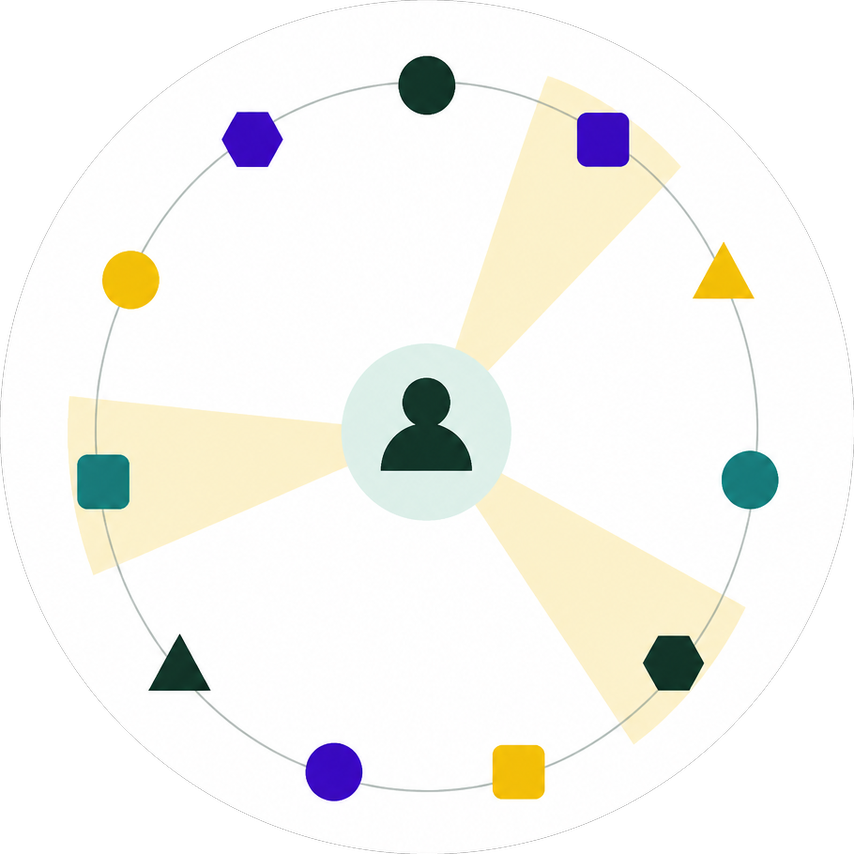
The Neurosetta Stone is what the book is for: a way for a person in one seat to understand how things work in seats they may not sit in, so that the people in them can understand each other. The whole book is the Neurosetta Stone. This is its glossary of translation: fifteen words that cause hand-off failures, each written from every seat, side by side. Each seat’s meaning is the correct meaning for what that seat is measured on. The failures happen when two seats use the word in the same sentence.
The book uses these terms in one fixed sense, kept beside the glossary so that neither kind of word is lost in translation.
- Accountability
- is the condition in which a person experiences meaningful consequences for the results of their decisions. It is a structural requirement, ensuring that the effects of a choice reach the person who made it.
- Asymmetry
- is an incentive structure in which the party who bears a cost is not the party who decides, or the party who benefits is not the party who pays. Wherever one appears in this book, a box labeled The Asymmetry sits beside the text and names both parties.
- Authority
- is the power to commit resources, resolve disputes, or govern outcomes. It takes distinct forms: scientific, evaluative, supervisory, administrative, budgetary, and decisional. These are different in kind, not different amounts of the same thing.
- Channel
- is the path by which a product, a referral, or a trial reaches a patient. In medicine the channels are clinical judgments: the physician’s referral or order, and the investigator’s choice of what to study and whom to enroll. The law forbids paying for them (Mech 21).
- Clinical neuro
- is the clinical neurosciences and clinical neurotechnology taken together: drugs, devices, procedures, and measurements aimed at the nervous system, the research behind them, and the people who live with the conditions they treat.
- Clock
- is this book’s word for whoever bears the cost of time at a given gate. A gate has a clock when some party with standing loses something if it is slow. Many gates in the field have a weak clock, one the gate itself barely feels.
- Collision
- is the point at which two seats use one word from the Neurosetta Stone in the same sentence and mean different things by it. Every mechanism in Part II names the collision where it acts.
- Dependency
- is a state in which a person’s professional options are restricted by financial, time-based, or identity-related factors. It differs from voluntary commitment or loyalty.
- Field diagnostic mechanism
- is a pattern that reliably produces similar outcomes under similar institutional conditions. Mechanisms are conditional, bidirectional, and actionable.
- Gate
- is a decision point run by a body that asks a question of the work before it may proceed: peer review, ethics review, regulatory authorization, coverage, payment, and point of care and purchasing.
- Harmonization
- is the condition in which many parts, each with its own measure and its own frequency, produce a good outcome together without being brought to one answer. Two people cannot be aligned without being the same person, and neither can two seats or two companies, so at any relational level harmonization is what is possible. A nervous system and a body do it; a field is not guaranteed to, and this book does not promise it. It is distinguished from alignment, which assumes one right answer and asks every part to reach it.
- Interpretation
- is the carrying of meaning from one seat’s language into another’s, as an interpreter does between speakers; it is distinct from translation, which in this field means carrying a finding from the bench toward the bedside. Both are needed, and only the second has a name in the field’s budgets.
- Legibility
- is how known a career path is: how long the line to enter it, how often it is named.
- Reward concentration
- is whether the path’s payoff is broad, reaching most who finish, or winner-take-all, reaching few. Mech 1 reads the paths by both.
- Navigation
- is knowing where a seat sits in the field, what the other seats are measured on, and which field diagnostic mechanisms act where seats meet. It asks for no agreement between seats, only that each knows the others exist; the craft of moving between them is diplomacy.
- Neurosetta Stone
- is what the book is for: an understanding of how things work in seats a person may not sit in, how each was trained, what it is measured on, where it is under stress, and how organizations look from inside one seat and from above, so that the people in them can understand each other. The whole book is the Stone; the fifteen words in Part I are its glossary of translation; every mechanism in Part II shows the Stone at work at a collision. It asks a seat to recognize another’s meaning, not to adopt it.
- Readiness
- is the condition of a system, technology, or organization that allows it to survive external scrutiny, create real obligations for outside parties, and sustain accountability through deployment. Readiness is best assessed against the specific demands of the next gate, not in the abstract.
- Resolution
- is closing a decision, question, or uncertainty in a way that cannot be undone by reframing it. It differs from deferral (delaying the decision), relabeling (renaming the problem), and completion (documenting that work happened without answering the underlying question).
- Seat
- is a position in the field defined by what it is paid for, what it is measured on, and what it can see. The twelve seats are described in Part I; two of them, the trainee and lived experience, are sometimes paid, sometimes unpaid, and sometimes pay.
- Signal
- is observable evidence that a system condition is present. Signals identify mechanisms; they do not cause them. Strong signals indicate a mechanism is severe or late. Early signals indicate it is beginning and recovery is still possible.
- Subsidy
- is an uncompensated transfer of money, time, or risk from one seat to another. Most subsidies in the field are unrecorded, because the seat that receives them holds the measure and the seat that gives them does not.
- Tacit knowledge
- is what a seat knows without knowing that it knows it: the assumptions so settled inside a domain that few there write them down, and so invisible outside it that few there think to ask. Most of what this book makes explicit was tacit somewhere.
- Working version
- is the positive counterpart of a mechanism: the structure that produces durability where the mechanism produces fragility. Every mechanism in Part II has one, in a fixed place.